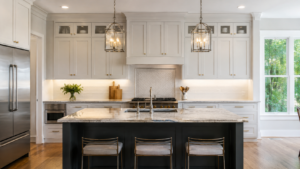

If your kitchen cabinets are structurally solid, refinishing gives you a near-new, factory-smooth look for far less than replacement — as long as the process is right: full degrease, sanding, a quality bonding primer, and a sprayed, durable enamel cured between coats.
Replacement usually makes more sense when the cabinet boxes are water-damaged, swollen, delaminating, or when the kitchen layout itself needs to change.
Refinishing or replacing kitchen cabinets in CT usually comes down to the condition of the boxes, not only the doors. In a home you plan to keep, refinishing solid cabinets can be one of the highest-value updates available because it changes the look of the kitchen without the cost, demolition, and downtime of a full replacement.
Homeowners planning cabinet work locally can also review Alves Pro’s cabinet painting and refinishing service to understand how cabinet prep, finish selection, and written scope should be planned before work begins.
This guide walks through the decision, then explains what a durable cabinet refinish actually takes.
Refinishing vs. Replacing: How to Decide
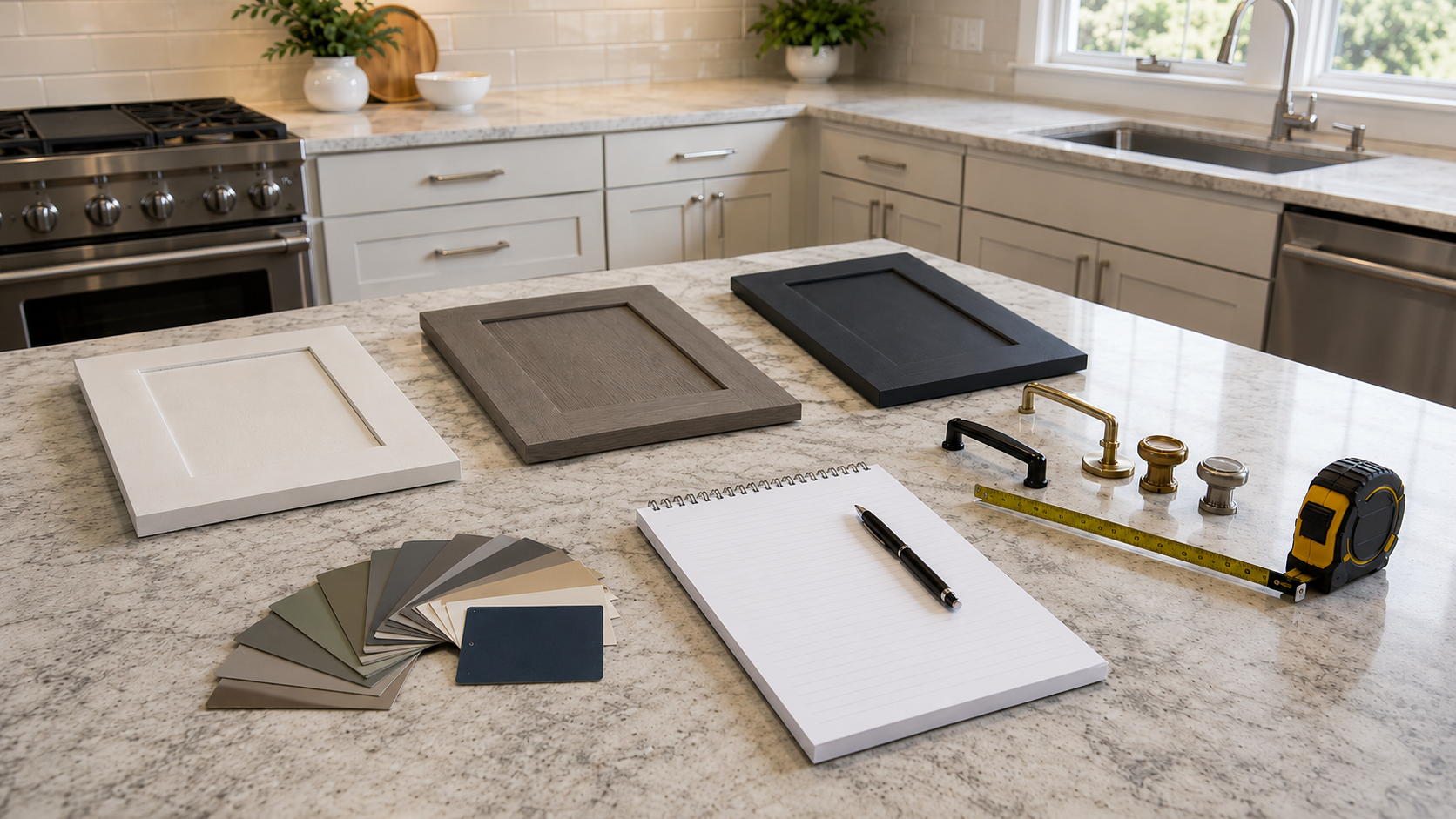
Refinishing vs. replacing comes down to a few honest questions about the cabinets you already have.
Are the boxes sound? Do you like the kitchen layout? Are the doors and drawer fronts a style you can live with after a professional finish?
If the answer is mostly yes, refinishing is usually the smarter spend. If the boxes are failing or the layout fights you every day, replacement earns its cost.
Cabinet Refinishing vs. Replacement Matrix
| Factor | Refinishing | Replacing |
| Box condition | Solid, stable, and free from major water damage | Swollen, delaminating, broken, or damaged |
| Layout | The current kitchen layout works for daily use | The layout needs to change |
| Cost | A fraction of full replacement | Highest cost, often with demolition and related trades |
| Downtime | Usually days, with the kitchen mostly intact | Often weeks, depending on teardown, ordering, and installation |
| Result | Near-new finish with the same cabinet footprint | New boxes, new layout, and a full replacement scope |
When Refinishing Is the Better Call
Refinishing is usually the better call when the boxes are solid and you are happy with the layout.
Quality cabinet boxes often outlast their original finish by decades. A professional refinish resets the look without tearing out cabinetry that still has plenty of life in it.
Cabinet refinishing often makes sense when:
- The cabinet boxes are structurally sound
- The current kitchen layout works well
- The doors and drawer fronts are in good condition
- You want a cleaner, brighter, or more updated kitchen
- You want less demolition and downtime than replacement
- You want a durable finish without changing the full footprint
In these cases, refinishing can deliver a major visual upgrade without turning the kitchen into a full remodel.
When to Replace Instead
You should replace instead when the boxes are water-damaged, swollen, delaminating, broken, or when the layout no longer works for how you cook and live.
No finish can fix a failing cabinet box or a bad floor plan. If cabinets are soft from moisture, separating at the edges, or poorly arranged for daily use, refinishing may become money spent twice.
Replacement may be the better choice when:
- Cabinet boxes are swollen or water-damaged
- Laminate or veneer is separating badly
- The cabinet layout creates daily frustration
- You need to move appliances or change the footprint
- Storage needs cannot be solved with the existing cabinets
- The doors, frames, or boxes are too damaged to refinish cleanly
The decision should be practical: refinish when the structure works, replace when the structure or layout is the real problem.
What Makes a Factory-Smooth Cabinet Finish
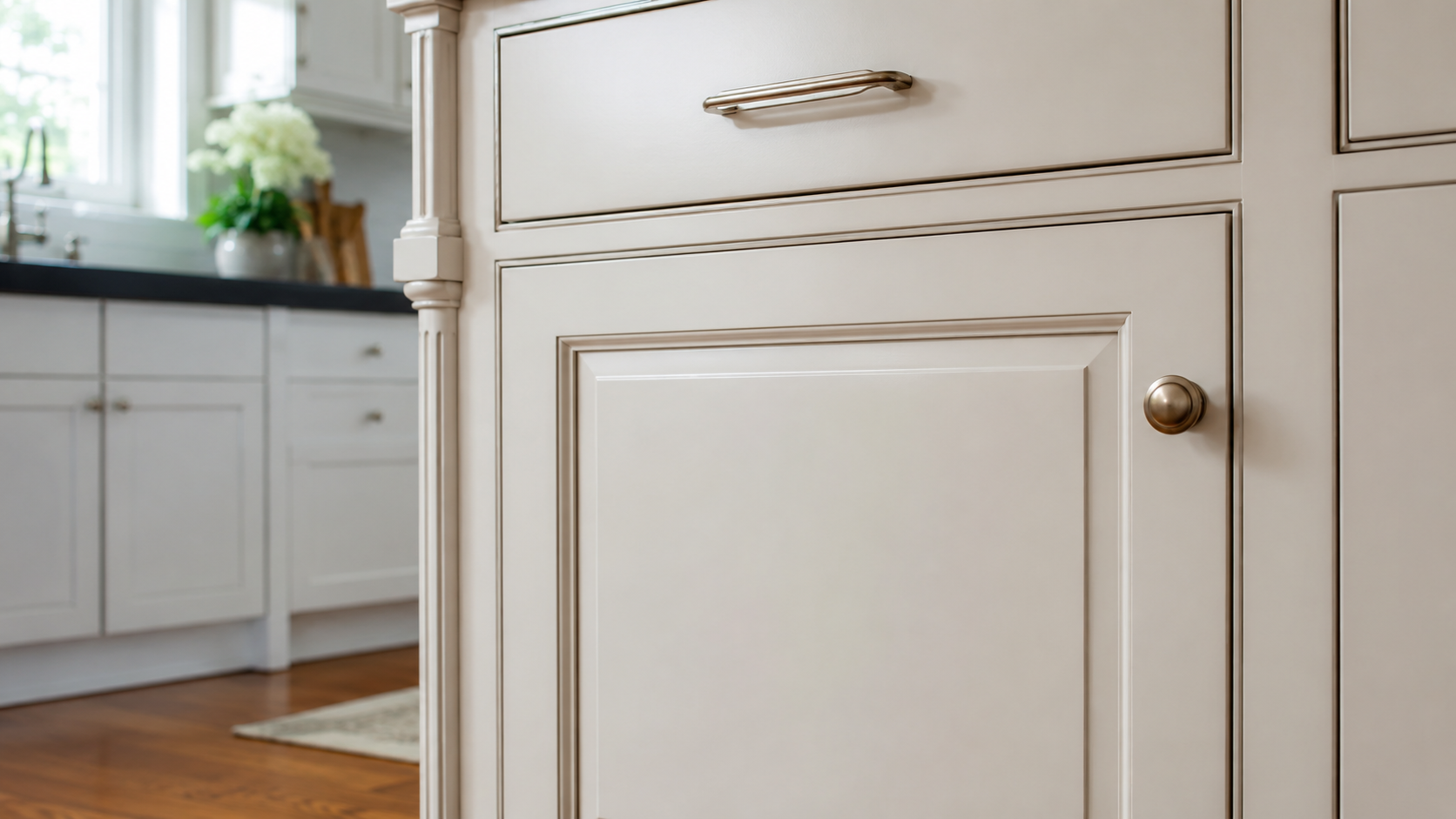
A factory-smooth cabinet finish comes from proper prep, spray application, and cure time, not brushwork alone.
Sprayed enamel lays down more evenly than a hand-brushed shortcut and helps avoid the texture that makes a cabinet project look like a weekend repaint.
Curing between coats is what helps the surface become hard enough for daily use. Cabinets face more handling, grease, steam, and cleaning than walls do, so the coating system has to be built for a higher-wear surface.
A strong finish depends on the full system: cleaning, sanding, bonding primer, application method, dry time, cure time, and careful reinstallation.
The Prep That Makes Cabinet Finishes Last
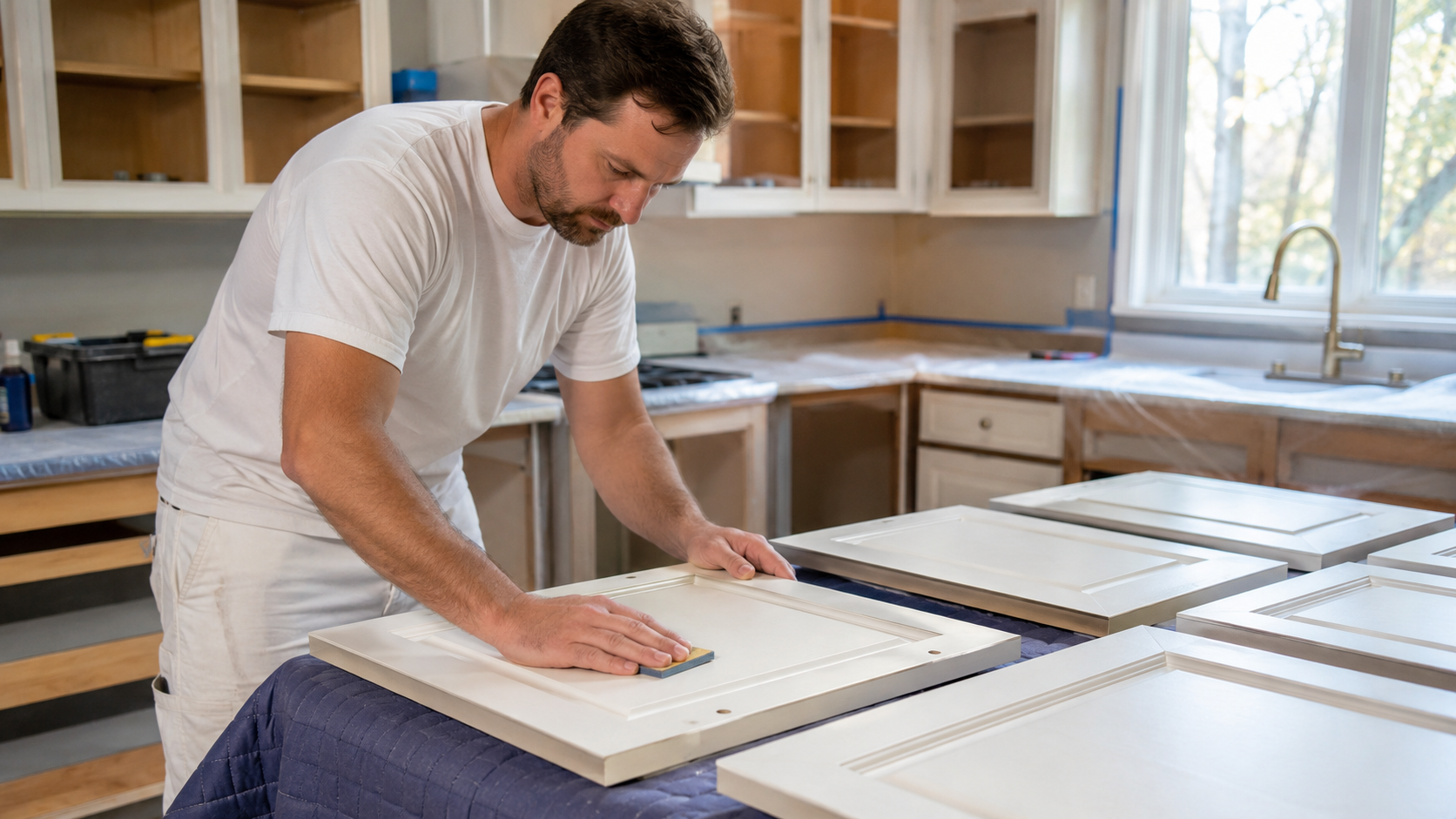
The prep that makes cabinet finishes last is more detailed than standard wall painting. Kitchen cabinets collect grease, steam, cooking residue, fingerprints, and daily wear.
That means every surface needs to be cleaned, degreased, sanded, and primed for adhesion before the finish coats go on.
Skip the degrease or the sanding and the finish can fail exactly where your hands touch most.
A stronger cabinet refinishing process should include:
- Removing or carefully labeling doors and drawer fronts
- Cleaning and degreasing cabinet surfaces
- Sanding for adhesion and smoothness
- Using a quality bonding primer
- Spraying durable enamel where appropriate
- Allowing proper dry and cure time between coats
- Reinstalling doors, drawers, and hardware carefully
Alves Pro works from our cabinet painting and refinishing process so homeowners understand what is included before work begins.
Timeline: How Long It Takes and Can You Use the Kitchen?
Timeline matters in a kitchen. Most refinishing projects run several days, and a careful crew stages the work so you keep as much use of the space as possible.
Depending on the process, doors and drawer fronts may be finished in a contained area while cabinet boxes are prepared and coated in place. The kitchen may still be partly usable, but homeowners should ask what will be available each day.
A written cabinet scope should explain:
- How long the project is expected to take
- Where doors and drawer fronts will be finished
- When the kitchen will be limited or unavailable
- How dust, odor, and overspray will be controlled
- When doors and drawers will be reinstalled
- When the finish can be used normally
Ask up front how long the kitchen will be out of normal service and what the daily plan looks like.
What Does Cabinet Refinishing Cost in Connecticut?
Cabinet refinishing cost in Connecticut depends on the number of doors and drawers, the current finish, the amount of prep required, the coating system, and whether the project includes boxes, frames, panels, islands, built-ins, or extra detail areas.
It is consistently a fraction of full replacement, but the estimate should still be specific. A cabinet quote should not be only a round number with no process attached.
For broader budget planning, homeowners can review painting prices in CT and then ask for a written, itemized estimate based on the actual cabinet count, prep needs, and finish expectations.
Cabinet Refinishing Often Pairs Well With Interior Painting
Cabinet refinishing often pairs well with wider interior work because kitchens rarely stand alone visually.
Fresh cabinets can make nearby walls, ceilings, trim, doors, or adjacent rooms feel dated if the rest of the space is not considered.
For homeowners already updating the kitchen, it can make sense to pair cabinets with a full interior refresh so the cabinet finish, wall color, trim, and surrounding spaces feel connected.
This does not mean every room has to be painted at once. It means the cabinet decision should fit the larger interior plan.
What a Written Cabinet Scope Should Include
A written cabinet scope should list the boxes, doors, drawers, prep steps, product, finish approach, and number of coats so “refinish the cabinets” becomes something you can actually check.
Before approving a cabinet refinishing estimate, homeowners should understand:
- Which boxes, doors, and drawers are included
- Whether hardware is removed, protected, or replaced
- How cleaning and degreasing will be handled
- What sanding and priming are included
- What finish system will be used
- How coats will be applied
- Where doors and drawer fronts will cure
- When the kitchen can return to normal use
Alves Pro connects cabinet refinishing to our process and written warranty so homeowners can compare estimates by preparation, durability, and clarity, not only by final price.
Refinishing Is a Finish System, Not Just Paint
Cabinet refinishing should be treated as a finish system. The result depends on the condition of the boxes, surface cleaning, sanding, primer, coating choice, application method, cure time, and reinstall quality.
When all of those pieces work together, a solid cabinet set can look near-new without being replaced. When one step is skipped, the finish may chip, peel, or wear early.
Cabinet Refinish Decision Checklist
| Question | What It Helps Decide |
| Are the boxes structurally solid? | Whether refinishing is a practical option |
| Is there water damage or swelling? | Whether replacement may be necessary |
| Does the layout work for daily use? | Whether the current footprint is worth keeping |
| Are doors and drawer fronts in good shape? | Whether the visible surfaces can refinish cleanly |
| Is the kitchen mostly a style issue? | Whether refinishing can solve the main problem |
| Do you want less demolition? | Whether refinishing fits the project goal |
| Do you need a new footprint? | Whether replacement is the better investment |
| Is the finish process clearly explained? | Whether the estimate is detailed enough to trust |
Refinish or Replace Cabinets in CT FAQ
Is it worth refinishing kitchen cabinets, or better to replace?
If the boxes are solid and the layout works, refinishing is usually the better value. It can create a near-new look for a fraction of replacement. Replace when boxes are damaged or the layout needs to change.
How long do refinished cabinets last?
With proper prep and a sprayed, cured enamel, a cabinet refinish can hold up for years of daily use. Prep quality is the biggest factor in how long the finish lasts.
Can we use the kitchen during cabinet refinishing?
Usually partly. Doors and drawers are often finished in a contained area and reinstalled later, so the kitchen is disrupted for days rather than weeks.
Do refinished cabinets chip or peel over time?
Not when they are prepped correctly. Chipping and peeling usually trace back to skipped degreasing, sanding, priming, or poor cure time, not to refinishing itself.
What finish is most durable for kitchen cabinets?
A sprayed, durable enamel cured between coats is usually the stronger choice. It levels smoothly and stands up to grease, steam, handling, and cleaning better than standard wall paint.
Get a Cabinet Refinishing Estimate in Connecticut
A cabinet refinishing estimate should help you decide whether your existing cabinets are worth keeping, what process they need, and what kind of finish will hold up to daily kitchen use.
Alves Pro House Painters helps Connecticut homeowners plan cabinet refinishing with written scopes, careful prep, and a process focused on durable, smooth cabinet finishes.
You can review cabinet projects in our portfolio, then get a cabinet refinishing estimate based on the condition, scope, and finish goals of your kitchen.
What Happens Next
- We review cabinet boxes, doors, drawers, layout, and finish condition
- We identify degreasing, sanding, priming, product, and cure requirements
- We explain the written cabinet refinishing scope before work begins
- You get an estimate that helps you decide whether to refinish or replace
Solid boxes matter • Prep creates durability • A smooth finish starts with process